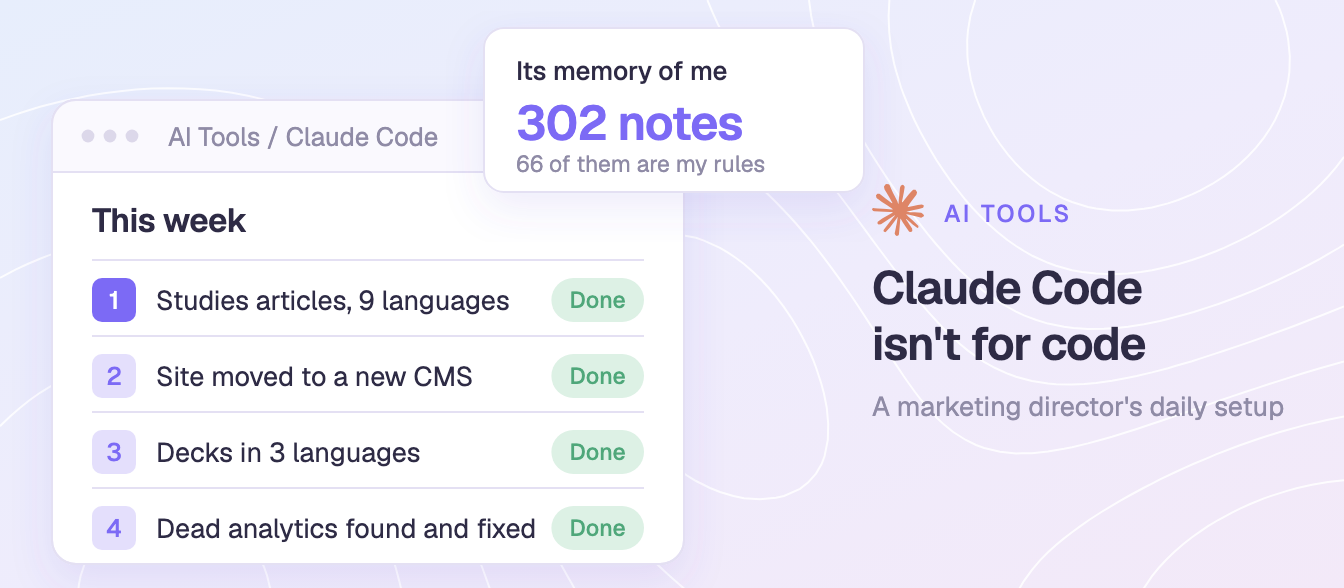
I'm a marketing director, not a developer. I lead a marketing team at a cloud provider and run a personal brand on the side. Claude Code gives me possibilities I've never had before. It makes my theoretical expertise accessible.
I've read a lot of theory: my textbook shelf alone holds 34 university textbooks. For years, knowing how something should be done and actually doing it were two different things, separated by developers, designers and budgets. Claude Code closed that gap.
What it does in a normal week
Almost none of it is code in the usual sense. In the last few months Claude Code has:
- moved this site from one CMS to another, Strapi to Payload, and deployed it to my own server;
- researched, written and published 28 articles for my Notion templates business in one wave;
- built company decks in three languages, stands and print layouts in Figma;
- found that this site's analytics had been silently dead for weeks, and fixed it;
- written, illustrated and published the article you're reading, in nine languages.

Beyond the task
My favourite thing is that it looks beyond the task. It takes into account more than I could figure out myself.
A real example from the day I published my Studies articles. I asked for translations. Along the way it found three things I hadn't asked about:
- The site ignored the language. Every language version showed English text, so translations would never have appeared.
- The contents sidebar dropped non-Latin headings. Russian, Chinese and Arabic headings vanished from it, and that had been happening to my older Russian articles too.
- Covers couldn't change per language. The cover field was shared by every language, so all nine versions would have shown the English cover.

None of this was in the brief. All of it would have cost me readers.
Tasks from Notion, reports in comments
I don't have to open a terminal to give it work. My tasks live in Notion. When I set AI Hand-Off to Claude on a task, a runner on my server picks it up within a minute, does the work and reports back in a comment, with a link to a Drive folder for any files. It has been running since August 2026.

- Scheduled tasks need no extra tool. A due date with a time means "start at that hour"; a due date without a time is just a deadline.
- Feedback has two channels. A comment on the task means "fix this now". A separate AI Feedback field means "next time, do it differently".
- A status column shows where the machine is: Queued, Running, Done, Needs input or Failed. When it's done, the task moves to Review for me.
One memory on two machines
Claude Code runs on my laptop and on my server. Both need to know the same things: who I am, my brands, my tools, my rules. So the configuration and memory live in one private repository, and both machines sync with it at the start and end of every session.

Today that memory holds 302 notes: 165 about projects, 68 references, such as where things live and how APIs behave, and 66 rules about how to work with me.
Rules it learned from me
Every rule in that memory comes with the reason behind it, so it can apply the idea, not just the words. A few of mine:
- Show a mockup before shipping anything visual. I once got a redesign deployed before I'd seen it.
- Take numbers from the source text, not from a machine summary of it.
- A question is a question. "Can we do X?" means answer it, not do it.
- Ad account changes only after my "yes" on each batch.
- An edit is exactly the edit I asked for, not a chance to redo the rest.
This is where I still do the important part myself: decisions, taste and the final "yes".
The clean-up
More is not better. In August I audited two months of usage:
- I had 554 skills installed and actually used 23. I cut them down to 73; today my main setup has 42.
- One skill, figma-use, accounted for 480 of 528 skill calls. More on that in my Figma article.
- 242 of 296 sub-agent runs had silently used the most expensive model. Now the model is picked for the job: a lighter one for mechanical work like collecting files and batch edits, the strongest one where thinking is needed.

Why I stay
Because the distance between "I know how this should work" and "it exists" is now a conversation. For someone whose expertise was mostly theoretical, that changes everything.