My not-so-good MBA attempt introduced me to three publishers: Pearson, Cengage and McGraw Hill. The degree didn't work out. The books stayed.
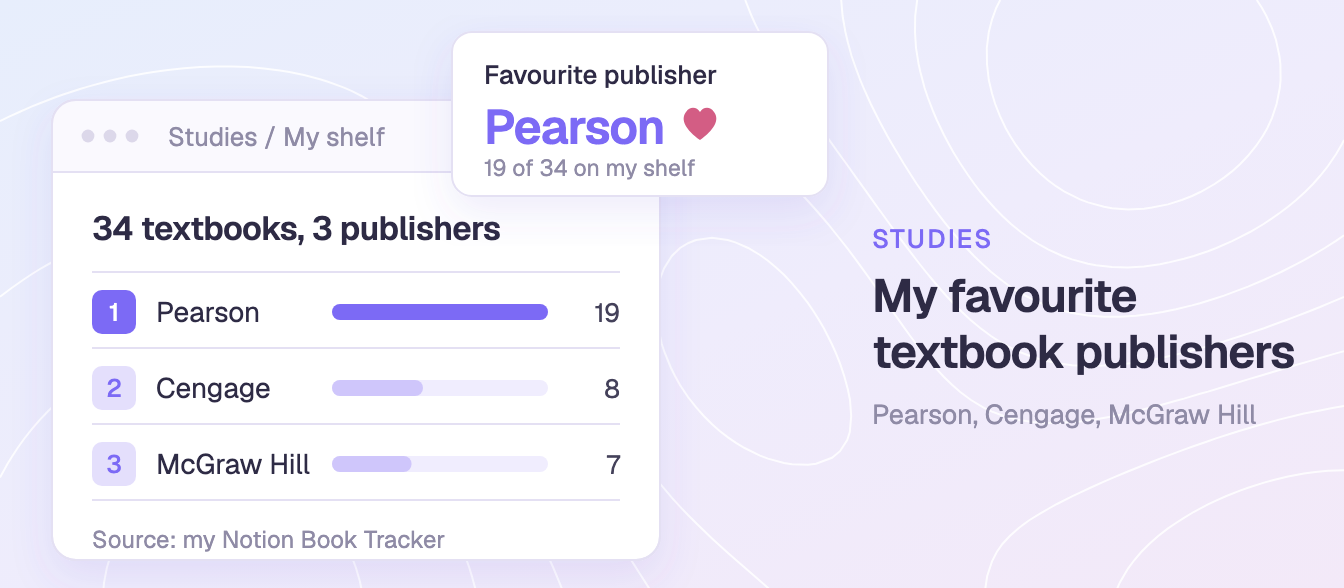
Today my Notion Book Tracker lists 34 of their textbooks: 19 from Pearson, 8 from Cengage and 7 from McGraw Hill. This is a short tour of that shelf: what I like about these books, how I read them, and what each publisher gave me.
What I like about textbooks
Popular business books are a great read. Most of them are built around one big idea, carried by stories, and read once. A university textbook does something different. For me it comes down to two things: structure and the next level of knowledge.

- Structure. A textbook splits a whole field into parts and chapters, and every chapter ends with a summary. You always know where you are and what comes next.
- Frameworks with real companies. Ideas come with named cases. In Kotler & Keller's Marketing Management, the chapter on business markets ends with Alibaba and Salesforce.com, and the chapter on marketing research with Tesco and LEGO.
- The next level. Endnotes point to the research behind each claim, so a chapter is a door rather than a wall. In my edition of Marketing Management the endnotes alone run from page 513 to page 574.
- Navigation. Contents, glossary, index. These books are built to be used as a reference years after you first open them.
How I read them
I rarely read a textbook cover to cover. I use two routes.

- Chapter by chapter, when I'm getting into a new area. Parts and chapters are ordered on purpose, so following them in order works.
- From the contents page, when I need one answer. I find the chapter that covers my question and read that chapter start to finish.
The second route is the one popular books can't offer. Their contents pages are a list of catchy titles. A textbook's contents page is a map of the field.
Pearson: one love
If I had to keep only one publisher, it would be Pearson. Nineteen of my 34 textbooks are theirs, including the one that changed how I think about marketing: Kotler & Keller's Marketing Management.
Pearson is the oldest of the three. It started in 1844 in Yorkshire as a building firm, S. Pearson & Son, and became an education-only company by 2016. It is listed in London, in the FTSE 100. Most of my copies are Global Editions: Pearson's international versions of its US titles, sold under their own ISBNs.
From my shelf:
- Marketing Management by Philip Kotler and Kevin Lane Keller (Alexander Chernev joined for the 16th edition)
- Management by Stephen Robbins and Mary Coulter
- Consumer Behavior by Michael Solomon (and yes, Michael and I are connected on LinkedIn)
- Human Resource Management by Gary Dessler
- Essentials of Organizational Behavior by Stephen Robbins and Timothy Judge
- Operations Management: Processes and Supply Chains by Lee Krajewski, Manoj Malhotra and Larry Ritzman
Pearson's study platforms are MyLab and Mastering, homework and assessment systems with the eTextbook built in, plus Pearson+, an eTextbook subscription. Since 2024 MyLab and Mastering have AI study tools that explain steps and summarise material.
Cengage
Eight of my textbooks come from Cengage, and two of them are by the same author, Richard Daft: one on leadership, one on how organisations are designed.
Cengage is the youngest name of the three, though not the youngest company. Its roots go back to 1979, when International Thomson bought the American publisher Wadsworth. The business grew into Thomson Learning, was sold in 2007 and renamed Cengage Learning. Today it is Cengage Group, a private company based in Boston.
From my shelf:
- The Leadership Experience by Richard Daft
- Organization Theory and Design by Richard Daft
- Strategic Management: Competitiveness and Globalization by Michael Hitt, Duane Ireland and Robert Hoskisson
- Organization Development and Change by Thomas Cummings and Christopher Worley
Its platforms are MindTap for most subjects and WebAssign for STEM homework. Cengage Unlimited is a student subscription that bundles all its platforms and eBooks for a term or a year.
McGraw Hill
Seven of my textbooks are from McGraw Hill, and they cover the most hands-on skills on my shelf: negotiating, running projects, speaking in public.
McGraw Hill dates its story to 1888, when James H. McGraw bought a journal for the railway industry. In 1909 he and John A. Hill combined their book departments into the McGraw-Hill Book Company. Today it is based in Columbus, Ohio, and has been listed on the New York Stock Exchange since July 2025 (ticker MH).
From my shelf:
- Negotiation by Roy Lewicki, David Saunders and Bruce Barry
- Project Management: The Managerial Process by Erik Larson and Clifford Gray
- The Art of Public Speaking by Stephen Lucas
- Entrepreneurship by Robert Hisrich, Michael Peters and Dean Shepherd
- Corporate Communication by Paul Argenti
- Personality Psychology by Randy Larsen and David Buss
- Business Ethics Now by Andrew Ghillyer
Its platform is Connect, with SmartBook, an adaptive reading mode inside it, and ALEKS for adaptive practice in maths, science and business.
One more piece of history: in 2019 Cengage and McGraw Hill agreed to merge. They called it off on 4 May 2020, after the US Department of Justice raised competition concerns.

The three at a glance
| Pearson | Cengage | McGraw Hill | |
|---|---|---|---|
| Started | 1844, Yorkshire | 1979, as Thomson; Cengage since 2007 | 1888 |
| Based in | London | Boston | Columbus, Ohio |
| Ownership | Public: London, FTSE 100 | Private | Public since 2025: NYSE |
| Study platforms | MyLab, Mastering, Pearson+ | MindTap, WebAssign, Cengage Unlimited | Connect, SmartBook, ALEKS |
| On my shelf | 19 | 8 | 7 |
| What I read them for | Marketing, management, people, operations | Leadership, organisations, strategy | Negotiation, projects, public speaking |
Where to start
If you want a textbook shelf of your own, start with the area you need now, not the whole field. Some pairs from my shelf:
| If you want to understand… | Start with |
|---|---|
| Marketing | Marketing Management (Pearson) and Consumer Behavior (Pearson) |
| Managing people | Management (Pearson) and The Leadership Experience (Cengage) |
| Strategy and organisations | Strategic Management (Cengage) and Organization Theory and Design (Cengage) |
| Deals and projects | Negotiation (McGraw Hill) and Project Management (McGraw Hill) |
Then do what I do: open the contents page first.
The MBA didn't stick. The shelf did.