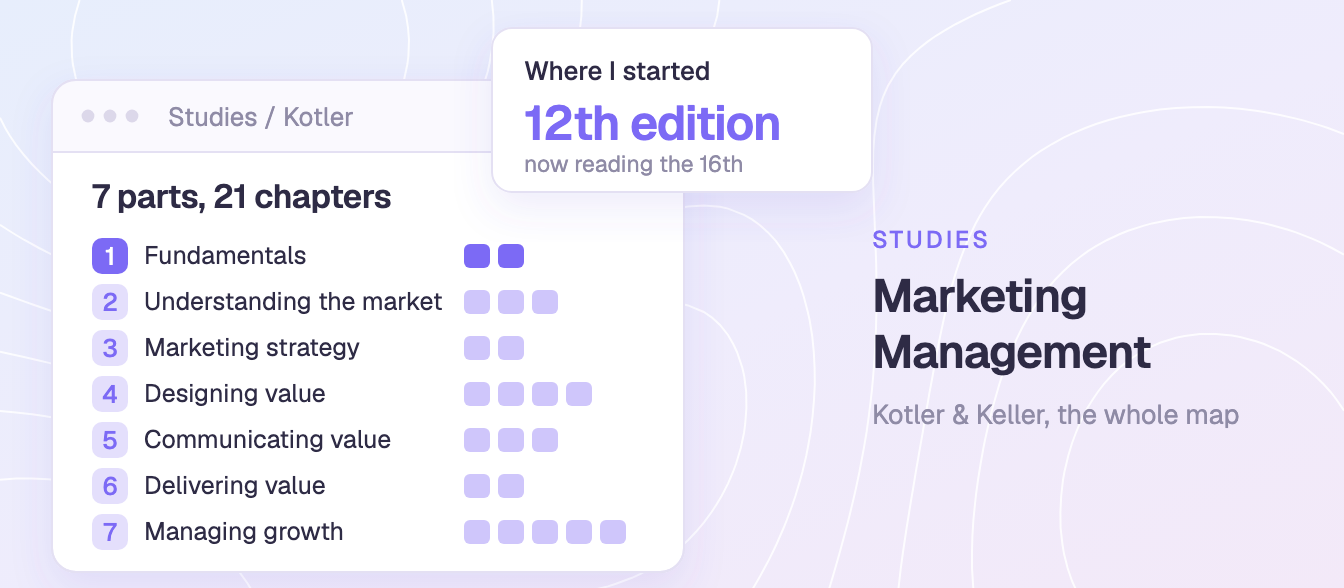
I met Marketing Management while downshifting in Turkey. It was the 12th edition, by Philip Kotler and Kevin Lane Keller, and my first impression went something like this:
"Wait, you could just know this instead of experimenting?"
Much of what I had been working out by trial and error was already in there: named, explained and put in order. These days I have the 16th edition on my desk and I'm updating myself on what has changed. This article is my map of it.
The book in a nutshell
Marketing Management first came out in 1967, published by Prentice-Hall, with Philip Kotler as its only author. Kotler taught at Northwestern University's Kellogg School of Management from 1962 and is often called the father of modern marketing. Kevin Lane Keller of the Tuck School at Dartmouth, known for his work on brand equity, later joined as co-author. Alexander Chernev, also of Kellogg, joined for the 16th edition.
Keller's faculty page calls it the all-time best-selling introductory MBA marketing textbook.

They update it often
The book doesn't go stale because it keeps being rewritten. Between the 15th and the 16th editions:
- The structure shrank from 8 parts and 23 chapters to 7 parts and 21 chapters.
- Chapters 1 and 2 were substantially rewritten: the first now sets out the scope of marketing management, the second gives a practical framework for planning.
- Communicating value now comes before delivering value, so the middle of the book follows one logic: design it, tell people about it, get it to them.
- New material covers business-model design (chapter 18), franchising (chapter 16) and corporate social responsibility (chapter 21).
The book on one page
The 16th edition reads like a value chain. You start by understanding the market, choose whom to serve, then design value, communicate it and deliver it, and finish with growth.

| Part | Chapters |
|---|---|
| 1. Fundamentals of Marketing Management | 1 Defining Marketing for the New Realities · 2 Marketing Planning and Management |
| 2. Understanding the Market | 3 Analyzing Consumer Markets · 4 Analyzing Business Markets · 5 Conducting Marketing Research |
| 3. Developing a Viable Market Strategy | 6 Identifying Market Segments and Target Customers · 7 Crafting a Customer Value Proposition and Positioning |
| 4. Designing Value | 8 Designing and Managing Products · 9 Designing and Managing Services · 10 Building Strong Brands · 11 Managing Pricing and Sales Promotions |
| 5. Communicating Value | 12 Managing Marketing Communications · 13 Designing an Integrated Marketing Campaign in the Digital Age · 14 Personal Selling and Direct Marketing |
| 6. Delivering Value | 15 Designing and Managing Distribution Channels · 16 Managing Retailing |
| 7. Managing Growth | 17 Driving Growth in Competitive Markets · 18 Developing New Market Offerings · 19 Building Customer Loyalty · 20 Tapping into Global Markets · 21 Socially Responsible Marketing |
Ideas the book is known for
Segments, targets and positioning (chapters 6–7)
Chapter 6 is about choosing whom to serve: strategic and tactical targeting, customer profiles, personas, and segmenting consumer and business markets. Chapter 7 turns that choice into a position in the customer's mind, built from three answers.

- Frame of reference. Which category do we compete in?
- Points of parity. What do we have to match to be considered at all?
- Points of difference. Why choose us over the others?
The chapter then shows how to write this down as a positioning statement and how to tell it as a story.
How businesses buy (chapter 4)
If you sell to companies, this is the chapter to read first. It explains buying centers, the group of people who make a purchase decision together, and walks through the buying process stage by stage.

The same chapter covers moving from products to solutions, building business-to-business brands, handling price pressure and managing buyer–supplier relationships.
Brands (chapter 10)
How branding works, brand equity, choosing brand elements and characters, brand portfolios and co-branding, the brand value chain, extensions and crises, and luxury brands. Two tools stand out: the brand mantra, a few words that capture what the brand is about, and the brand positioning bull's-eye.
Loyalty (chapter 19)
The customer acquisition funnel, satisfaction and loyalty, complaints, word of mouth and customer lifetime value, with a section on the Net Promoter Score.
Growth and new offerings (chapters 17–18)
Product–market growth strategies, defending a market position, the product life cycle and the stage-gate approach to developing new offerings, from idea generation and validation to business-model design and launch.
Real companies on every page
Each chapter closes with "marketing spotlights", short case studies of real companies. Chapters 4 to 21 alone end with 38 of them: Alibaba, Salesforce.com, Tesco, LEGO, Superdry, Chase Sapphire, Unilever's Axe and Dove, First Direct, Apple, Casper, Toyota, Premier Inn, Transport for London, Gucci, MUJI, Priceline, Uber, Red Bull, Cadbury, Honda, AccorHotels, Avon, Progressive Insurance, Zara, Popeyes, Uniqlo, Best Buy, Airbnb, American Express, Honest Tea, WeChat, Stitch Fix, Emirates, Sephora, Mandarin Oriental, Starbucks, Ben & Jerry's and Tiffany & Co.
How to read it
I read it the way I read every textbook: chapter by chapter when I'm learning an area, or straight from the contents page when I need one answer. With 21 chapters, a route helps. Some starting points:
| If you… | Start with chapters |
|---|---|
| Are new to marketing | 1, 2, 6, 7 |
| Sell to businesses | 4, 14, 19 |
| Build a brand | 7, 10, 12, 13 |
| Launch a product | 8, 11, 18 |
| Grow an existing business | 17, 19, 20 |
Why it still matters
Early in his career Kotler started asking whether marketing was "limited to just selling more toothpaste", as he later told Northwestern's alumni magazine. Sixteen editions later, the answer fills 21 chapters.
For me the value hasn't changed since Turkey. The book replaces guessing with knowing. And because they update it often, it's worth coming back to: I'm doing exactly that with the 16th.
More from my shelf: my favourite textbook publishers.